Posted 30-year mortgage rates slipped this week, following a prior-week pickup in borrower applications, yet the housing market remains largely muted for buyers and sellers. For the week ending November 20, 2026, mortgage applications increased 6.1% from one week earlier, according to Mortgage Bankers Association survey data reported by HousingWire. Even so, October home sales fell 4.7% from September and dropped 16.7% from the same month in 2025, per National Association of Realtors figures cited by Deseret News.
At the same time, homeowners are drawing heavily on existing equity. Outstanding balances on home equity lines of credit grew by $23 billion during the third quarter of 2026 to reach $481 billion, according to International Business Times. Over the past year, HELOC balances rose by $59 billion, an annual gain of approximately 14%, the same report noted.
Home equity takes over borrower demand
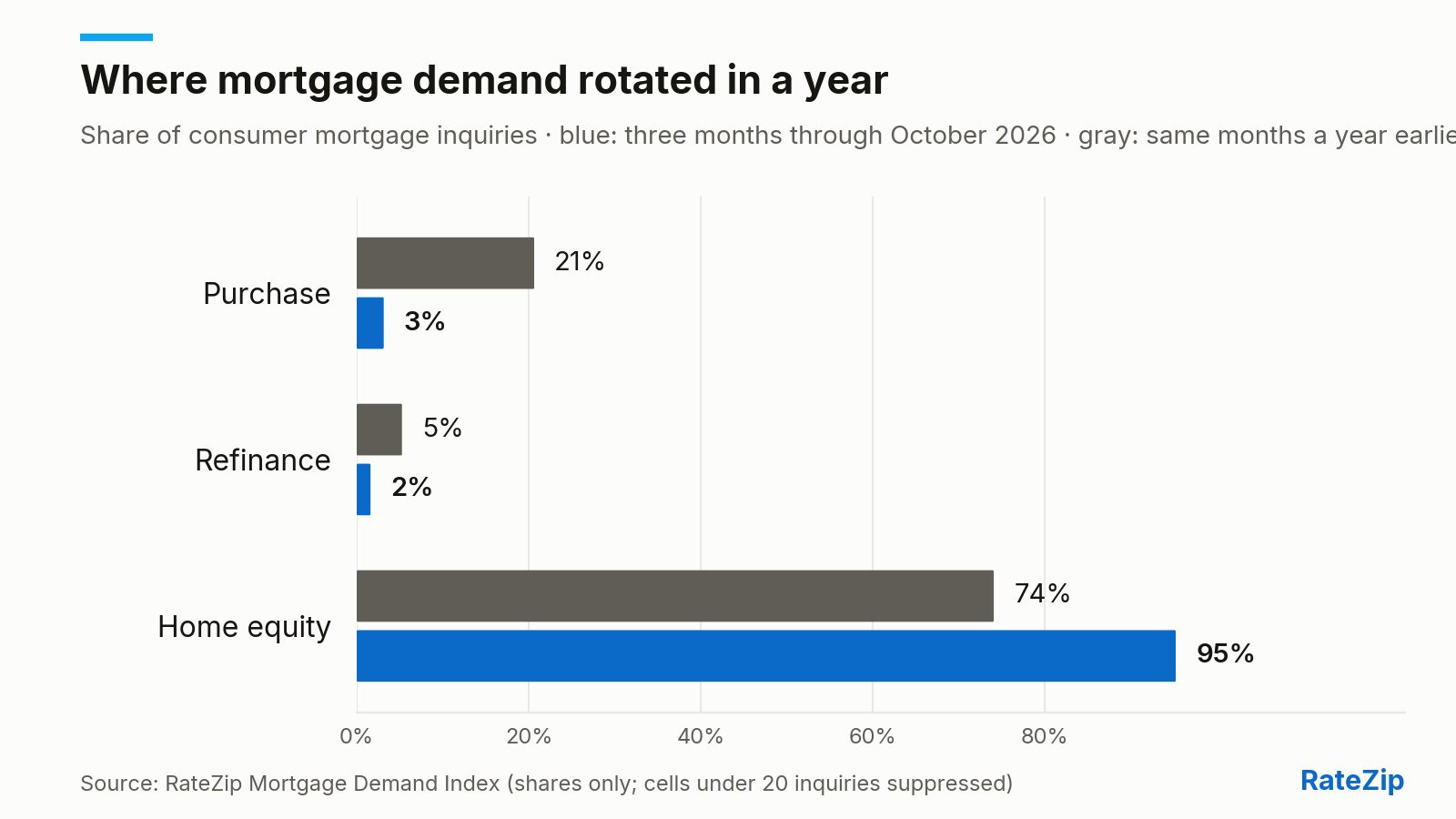
Inquiries submitted across RateZip's network show how sharply borrower interest has shifted toward home-equity products, though the figures reflect RateZip's network rather than all mortgage shoppers. Across the three months through October 2026, home-equity products — HELOCs and reverse mortgages combined — accounted for 95% of network mortgage inquiries, up from 74% during the same three-month stretch a year earlier, according to RateZip's Mortgage Demand Index. Purchase inquiries fell to 3% from 21% over that span, while refinance inquiries declined to 2% from 5%, a 21-percentage-point rotation toward home-equity products in twelve months. The inquiry series changed source systems in March 2026, a boundary documented on the Mortgage Demand Index page.
Lenders are also widening their push into home equity. This week, Better Home & Finance partnered with a mortgage servicer to market home equity loans and credit lines directly to that servicer's current customers, aiming to bring in leads at a lower cost while expanding partner distribution for its AI-driven HELOC product, according to a company update via 6ix. "A HELOC can unlock a down payment without unlocking a move," Adam Hopson, chief operating officer of Flyhomes, told HousingWire. Tapping equity can give owners cash toward buying a next home ahead of listing the place they live in now, Hopson explained, though taking on extra debt may complicate approval for a replacement loan.
How posted rates compare with the 10-year Treasury
In the bond market, the 10-year Treasury yield — the benchmark that long-term mortgage pricing most closely tracks — closed at 4.91% on Tuesday, November 24, down 13 basis points from a week earlier, according to FRED. Across the lenders RateZip tracks, posted 30-year fixed rates ended the week an average of 0.18 points lower. On November 26, RateZip's tracking showed advertised 30-year fixed rates spanning from 6% (6.56% APR) at AmeriSave and 6.625% (6.75% APR) at Tomo Mortgage — down 0.125 percentage points from its previous reading — up to 7.5% (7.599% APR) at New American Funding, alongside a 7% variable HELOC rate and APR at FourLeaf Federal Credit Union. Tuesday's Treasury close and Thursday's lender quotes measure different instruments on different dates. The comparison does not establish a causal relationship. Still, for a homeowner or buyer weighing a new mortgage against tapping home equity, the spread between those posted rates and APRs shows how much lender assumptions on credit, points, fees, loan size and eligibility shape advertised pricing — meaning the gap between quotes is not a matched offer or verified savings for any one borrower.
The outlook for borrowers
Even after this week's dip in posted rates, borrowing costs may have limited room to fall heading into December. Danielle Hale, Realtor.com Chief Economist, told RISMedia, "Inflation continues to exceed the Fed’s target raising expectations for a December Fed rate hike, placing a floor under interest rates, including mortgage rates." Meanwhile, Bright MLS Chief Economist Lisa Sturtevant noted in a separate RISMedia report that would-be buyers are staying hesitant as 2026 winds down, even where builders deploy financing incentives and rate buydowns. If mortgage rates stay near a floor into year-end, homeowners weighing whether to sell or stay put will continue to face the same backdrop that has accompanied surging HELOC balances and a home-equity-dominated inquiry mix.
One note on the data: the inquiry series changed source systems between the two windows compared here (completed March 2026); the boundary and how it is handled are documented on the Mortgage Demand Index page.
Read more
Mortgage-demand figures come from RateZip's Mortgage Demand Index: consumer mortgage inquiries across our network, expressed as shares and percent changes. Lender-posted rates come from RateZip's stored lender-posted rate observations, the same data behind our daily Mortgage rates today report. The 10-year Treasury yield comes from the Federal Reserve's FRED series. Other reported facts and quotations are attributed to their sources inline. How we collect and publish our data: our rate methodology. RateZip is a licensed mortgage broker (NMLS #1592292); this story describes what borrowers and lenders are doing and is not advice about what any reader should do.
RateZip is operated by Peklava LLC, DBA RateZip, a licensed mortgage broker (NMLS ID 1592292). We are compensated by some of the partners shown, which may affect which offers appear and where. It does not affect our reporting or recommendations. See our editorial standards.