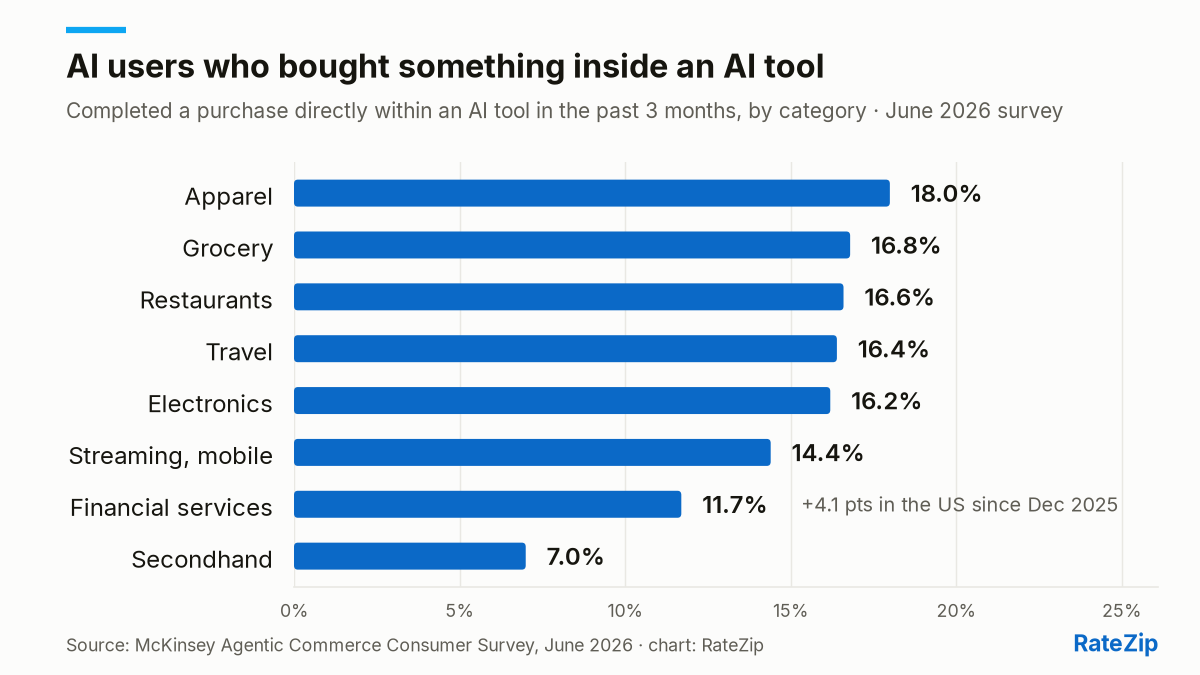
Graphic: RateZip. Source: McKinsey, "Who wins when AI does the shopping? New evidence on agentic commerce", October 28, 2026.
People aren't only asking AI assistants about money anymore. Some are buying through them. In McKinsey's June 2026 survey of about 21,000 consumers in 11 markets, 11.7% of AI users said they had bought a financial product or service directly inside an AI tool in the past three months. In the US, that share is up 4.1 percentage points since December 2025.
That's behind apparel (18.0%) and groceries (16.8%), but it's not zero, and it's growing.
What the survey found
- Most people have tried it. 53% of consumers across the 11 markets used AI for at least one shopping task in the past three months. In the US it was 48%.
- Buying through AI is climbing fast. Among US AI users, the share who completed a purchase with AI rose from 10% to 17% in a year.
- AI is replacing the search box. AI users were 3.2 times more likely to rank AI search tools as more influential than traditional search.
- Clean data wins. McKinsey cites Shopify, which reports that AI searches that hit its structured product catalog convert at about twice the rate of searches that rely on scraped or stale data.
Why a loan is different from a pair of shoes
McKinsey doesn't say which financial products people bought, and that matters. Opening a savings account or buying a simple policy can happen in a few clicks. A mortgage or a home equity line can't. A lender has to check your credit with your permission, verify your income and your home, give you required disclosures, and have a licensed loan officer stand behind the offer.
So for loans, an AI assistant's real job right now is research. It builds the shortlist. You and a lender still do the rest.
That makes the shortlist the part to get right. An assistant that quotes a rate from a page it read three weeks ago will send you in the wrong direction, and it will sound just as confident as one with today's numbers.
How to shop rates with an AI assistant
- Ask where every number came from. A good answer names the bank or lender and says when the rate was seen.
- Check the lender's own page before you apply. Rates change, sometimes daily.
- Compare the right number. For a loan, look at the APR, not just the rate. For savings, check what you have to do to earn the advertised APY.
- Keep sensitive data out of the chat. Don't paste your Social Security number or account numbers into an AI tool. Give those only to the lender, on the lender's site.
- Remember a rate isn't an approval. Your actual offer depends on your credit, your home and your loan.
What RateZip is doing about it
We've tracked the rates banks and lenders actually post for almost 20 years, and we show the source next to every number. When people started asking AI assistants instead of search engines, we put that same data where they're asking. RateZip Deposit/Mortgage Rates is in the ChatGPT app directory and works in Grok and other AI apps that support MCP, so an assistant can pull our observed rates, with the source and the date, instead of guessing. Here's how it works.
If AI is going to build people's shortlists, the numbers on it should be real and current. That's the part we can fix.
About the data
All figures come from McKinsey's Agentic Commerce Consumer Survey, fielded in June 2026, as published in McKinsey's October 28, 2026 article. The category figures are the share of AI users who completed a purchase directly within an AI tool, once or more than once, in the past three months. McKinsey titles that chart "US AI users," while its footnote gives the base as all AI users across 11 markets (weighted, n = 11,088); the change since December 2025 is for US respondents only. The chart shows eight of McKinsey's 16 categories. McKinsey doesn't break financial services and products down by product type.
Peklava LLC, DBA RateZip, is a licensed mortgage broker, NMLS ID 1592292. Rates change often, so check the source before you decide. See our editorial standards.