Having enough money to buy a home does not necessarily mean being ready to choose one. For some wealthy renters, a lease is a way to try out a neighborhood before making a much larger commitment.
The group is growing. An October 15 RentCafe analysis estimates that roughly 18,400 U.S. renter households earn at least $1 million annually. Their number rose 229%, compared with 193% for homeowners at that income level. These are income measures, not net-worth measures, and the comparison uses overlapping five-year Census estimates ending in 2020 and 2024, rather than two single-year snapshots.
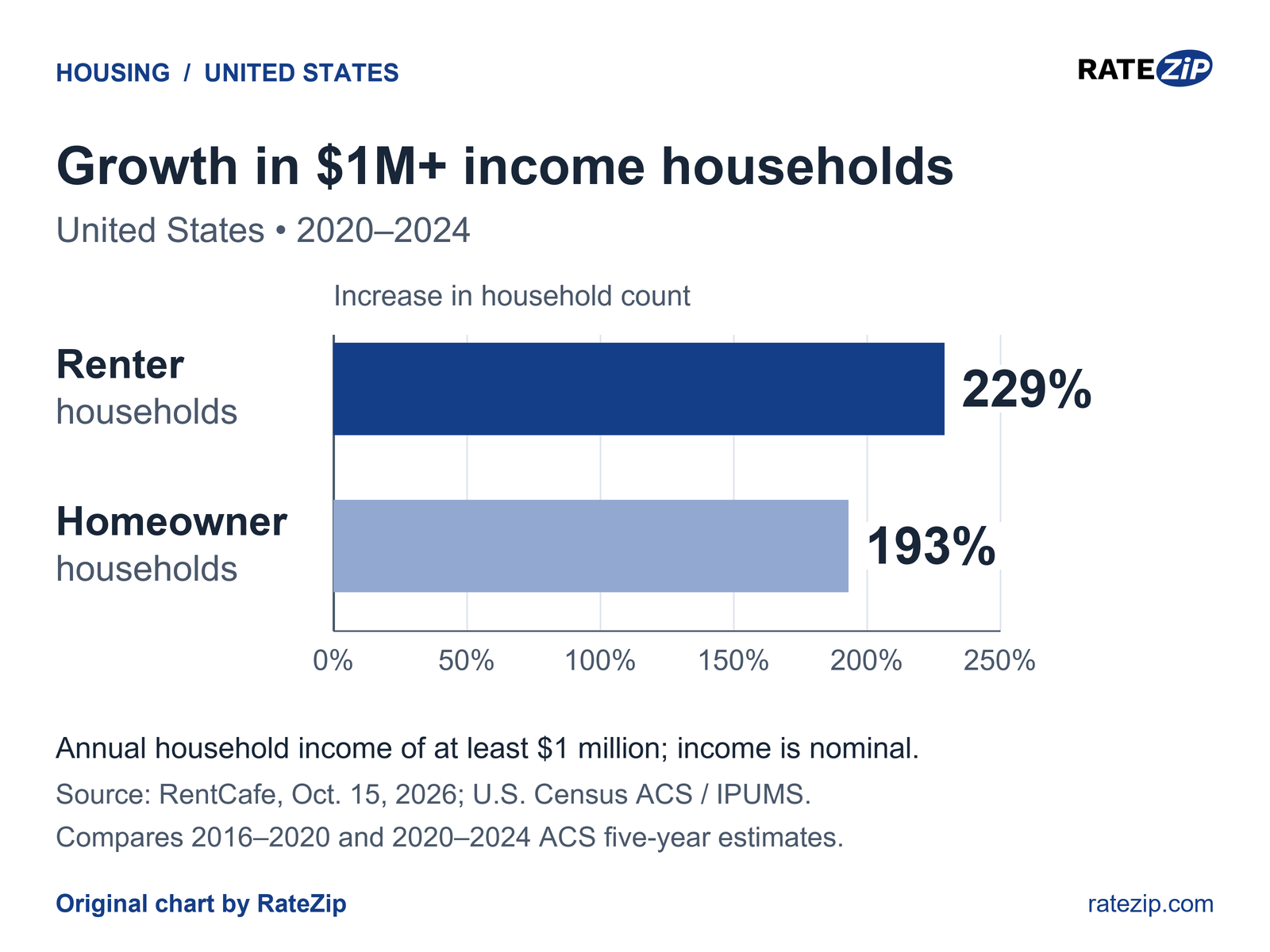
Chart: RateZip. Source: RentCafe's analysis of ACS/IPUMS data. Percentages describe growth in household counts, not the share of wealthy households renting or owning.
The figures establish that more high-income households rent. They do not track the same people switching from owning to renting, or establish why any particular household made its choice.
A trial run before buying
In Naples, Florida, Realtor Kara Heaslip of John R Wood Christie's International Real Estate sees clients using that time to test a lifestyle. In written comments supplied to RateZip through Qwoted on October 17, she described clients who rent for two or three years before deciding to buy in the same neighborhood.
During those seasons, they learn which amenities they use, make friends and find out whether the community actually suits them. Her account offers a reason that an affluent household might keep renting even after identifying a city where it wants to live: choosing Naples and choosing a particular neighborhood are separate decisions.
Heaslip said most of her relocating clients have come from New York and New Jersey, with more arriving from California. She described taxes as a major consideration for those clients. That is her experience with her own customer base, rather than a finding about every household in RentCafe's national data.
RentCafe estimates that Naples' million-dollar-income renter households increased from seven to 76 across the periods it studied. The small starting count matters: a large percentage increase can still represent a relatively small group of households.
Mortgage rates do not explain every lease
Mortgage costs remain part of the broader housing backdrop. Freddie Mac's October 15 survey reported a 7.40% average for 30-year fixed mortgages. That is a national interest-rate benchmark, not APR or an individual borrower's offer.
But Heaslip's clients often approach a purchase without a mortgage. She estimated that about 90% of her buyers pay cash and said her average sale is $1.5 million or more. Those figures describe her business; they are not Naples-wide statistics.
“From my own experience, rates are not what’s stopping the wealthy from buying,” she said.
For these clients, she described the deciding factor as finding a property and neighborhood that fit. She does not expect falling rates alone to produce a surge of buyers in her market. That is her assessment, not a forecast established by the national rental figures.
Her account adds a useful distinction to the discussion of wealthy renters. Some may be waiting to buy, but the thing they are waiting for is confidence in a particular home and community. A lease can give them time to reach that decision.
About the data
RentCafe used ACS/IPUMS five-year estimates for 2016–2020 and 2020–2024. The periods overlap, and household income is nominal, without adjustment for inflation. Its $1 million threshold refers to combined annual household income. The estimates do not identify households' motivations. Heaslip's comments are a separately reported, local perspective and do not establish a national cause.
RateZip is operated by Peklava LLC, DBA RateZip, a licensed mortgage broker (NMLS ID 1592292). We are compensated by some of the partners shown, which may affect which offers appear and where. It does not affect our reporting or recommendations. See our editorial standards.